
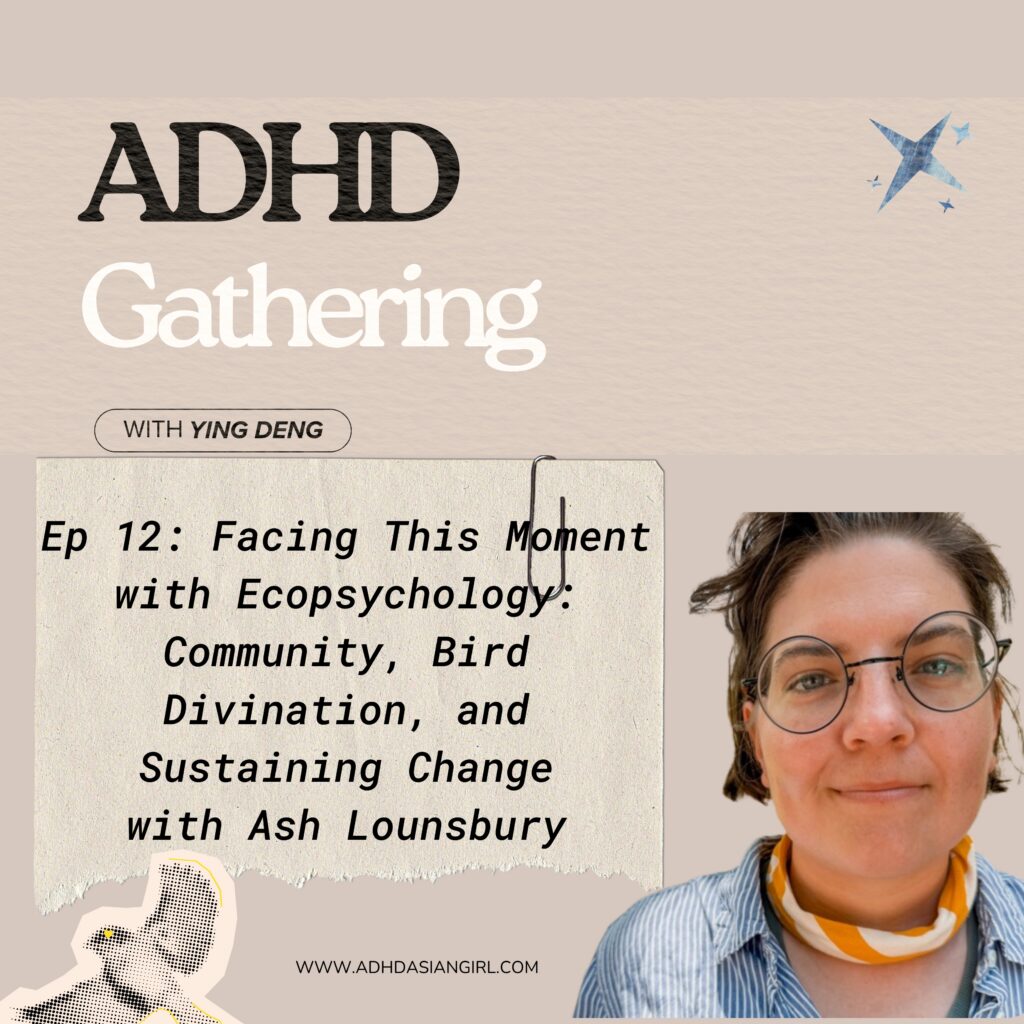
Listen now on Apple Podcast and Spotify
Resources:
- Download a free ADHD emotional regulation menu
- Booking a free coaching discovery call with Ying, an award winning ADHD coach & meditation teacher featured on Self Magazine
Guest’s Bio:
Ash Lounsbury is an ecopsychologist and enrolled citizen of the Wahzhazhe (Osage) Nation. Ash holds a non-clinical Master’s in Ecopsychology from Naropa University and Level 1 and 2 certificates in ecotherapy from the Earthbody Institute. Her graduate research culminated in a dissertation on the intersection of ancient bird divination and contemporary ecotherapeutic modalities. Ash sometimes writes about myth, ecohealing, queerness, and birds.
With over a decade of meditation experience, she’s had the honor to support Tara Brach and Jack Kornfield’s virtual meditation community members. In 2025, she co-founded Earthwild Ecology Club where she co-facilitates virtual ecopsychological workshops.
Wake! Ecohealing https://wakeecohealing.com/
Earthwild Ecology Club https://www.earthwildec.org/
IG: @wake.ecohealing
Transcript
This is the first installment of a new mini series on ADHD Gathering. The seed that started this for me is a question I really want to ask: how do we face this moment? I thought the best way to explore it was by dialoguing with some of my friends and great teachers. (Ying)
Ash Lounsbury is an ecopsychologist and enrolled citizen of the Osage Nation. She holds a nonclinical master’s in Ecopsychology from Naropa, and Level 1 and 2 certificates in Ecotherapy from the Earth Body Institute. Her graduate research culminated in a dissertation on the intersection of ancient bird divination and contemporary eco-therapeutic modalities. With over a decade of meditation experience, she’s had the honor of supporting Tara Brach and Jack Kornfield’s virtual meditation community members. In 2025, she co-founded Earth Wild Ecology Club, where she co-facilitates virtual ecopsychological workshops.
Ash and I met at Cloud Sangha when we were working together, and we’ve since become good friends. I’m so glad she said yes to being the first voice in this series.
Ying: How are you experiencing this moment? What are you perceiving?
Ash: I’m gonna start with the present moment. Right now the sun is shining. It feels like spring is really on its way. We were encased in snow the past week and I’m feeling a lot of relief that the earth is warming up, bugs are coming out, birds are singing.
And I’m also holding that with an awareness of the polycrises that’s engulfing our world. It feels global, politically and climatically, and then also at these micro levels of the community. My own community, and knowing that a lot of people’s local communities are also undergoing this struggle.
(We’re recording on February 13th, 2026, the first day that Saturn moved into Aries, right after a historic snowstorm on the east coast of the United States. I’ve been noticing more birds singing in the mornings, and getting genuinely excited. Oh, spring is coming.)
Ying: How do your identities, neurodivergence, cultural background, shape your experience and response to this moment?
Ash: I have the privilege of navigating the world as a cisgender, white, able-bodied human. That gives me more financial fluidity and stability. I don’t have the same experience as somebody who has a different body. I want to speak to that, I’m coming from a privileged place.
I’m able to face the challenges of the world with this ecopsychological understanding because I had the privilege of time and access to higher education. It allowed me to deepen my understanding and re-remember my connection to the earth. Which is also a privilege, because for a lot of people, the intersection of nature and humanity can be a point of danger, when you have to weather storms and don’t have access to shelter.
And also, thanks for bringing up neurodivergence. I’ve been thinking a lot about autistic joy. I still don’t have a clean definition for what that means, but there’s something about leaning into my own autistic joy of feeling embodied. Like speaking to the sun and really feeling the warmth of that.
I also want to name that whenever I enter social justice spaces, and this is anecdotal, it seems like there’s this overlap between neurodivergent folks and folks who are really into social justice. For me it feels almost rule-based. I’m like, we should all be following these core rules as humans, minimizing suffering and harm. And then I’m seeing systems that are not following those rules, and something in me wants to shift the system.
Ying: You mentioned experiencing the world through an ecopsychology lens. What is ecopsychology, and how has it changed you or helped you meet this moment?
Ash: Ecopsychology is the study of human relationship with nature. And I just want to name: humans are nature. So it’s also a relationship with self. We’re all part of this interconnected Earth body.
I had the privilege of having an eco-therapist as a counselor for a few years during the pandemic. And now I have another therapist who’s also an eco-therapist. I was able to drop into this healing space of being with nature.
What I studied at Naropa involved recollections of childhood memories of being in nature, and this idea of ecological identity, which goes back to generational examination. One of our tasks was to interview a living ancestor about their relationship with nature, and ask how that trickles down. I find that fascinating.
Ying: How does ecopsychology show up in your general daily life?
Ash: It feels constant to me. Once I’ve opened this, it’s like I have a lens I’m seeing the world through and I can’t shutter it.
There’s something about animism in that too, the earth as a living thing. There’s a scholar, James Lovelock, who talks about the planet almost like a redwood tree: if you dissect the redwood and see the rings, you can see the earth replicated. You have the heartwood, the inner matter, like the core of the earth, and then it becomes more lively as you get closer to the outer rings of the bark. So you can imagine the earth like that, and where we’re like inhabitants on this redwood earth.
Thinking about that, I get a lot of sense of belonging. I have practices in place because sometimes I dissociate or compartmentalize, I’ll get into a trance of doom scrolling and just become this pair of eyeballs instead of an actual human.
Watching the sunrise has been one of my favorite ecopsychological practices. Watching this transformation from darkness to light. And it goes back to how winter is coming into spring, slowly.
Ying: What are the practices that are sustaining you right now?
Ash: I feel like I’ve had this fortune the past year or so to accumulate a lot of practices. One I want to name is being in community. Virtual sangha spaces, that feels like such a rich container, where I can set down this heavy load and feel witnessed by other humans.
Talking to friends. Talking to you about the different landscapes we’re each navigating, how there are differences in our experience and then this underlying similarity. Sometimes hopelessness comes over me, and when I reach out and talk to friends, it seems to mitigate that. Oh, we’re in this together.
And then hanging out in nature, where that is the collective space. That can look small, witnessing the sunrise from inside, just opening the blinds. It doesn’t have to be an extravagant hike. When I’m out walking the dogs, just taking time to witness the birds who are there.
Ying: Tell me about bird divination, what is it, and what drew you to it?
Ash: Bird divination is actually one of the ways I’ve been filling my cup, and also offering to others through community workshops, both in person and virtually.
I had this professor, Dr. Tina Fields, at Naropa. She provided a practice where we used nature as oracle. She had us go find large rocks, we were coming from all over the country and were each tasked with bringing a large rock to Colorado. Then we took turns rock scrying: looking at the fissures and markings of the rock to answer our deep, sacred questions.
In the lecture leading up to that, she mentioned bird divination. I’ve always loved watching birds, relating to birds, getting this deep sense of belonging from them. I’ve had one of my first spiritual experiences in nature with a hawk who soared by at eye level right behind me, was looking at me. So when she mentioned bird divination, I was like, what is that? My research cap immediately went on.
I was able to research bird divination as an eco-therapeutic modality for my graduate dissertation. That started this whole train. I offered the practice to my ecopsych cohort and they really loved it. Then I started offering it to the community in Asheville, shortly after Hurricane Helene came through, and a lot of people were facing climate anxiety and ecological grief.
Since then I’ve been offering these seasonal workshops. You come with a sacred question, similar to pulling from a tarot deck. We meet in a park, I invite people to go wander the land and witness the birds for 10 minutes, and then we come back and share our experiences.
Right now the inquiry I’ve been bringing to the birds is: how can I sustain a wave of change? When I’m out walking the dogs, I hold this question in my heart and just see who shows up.
It’s a practice of meaning-making, which I think is really important for humans, to assign meaning to things we’re interacting with every day. There are also studies showing that birdsong signals safety to our bodies, so it’s physiologically grounding. And there’s magic in practicing in the collective: when we’re in a group sharing insights, someone else’s insight reminds you of some fire that’s within you. That’s really magical.
Ying: What does engaged, value-driven action look like for you right now? What feels possible, and what feels necessary?
Ash: I’ve had this honor to volunteer with the Work That Reconnects Network, Joanna Macy’s network. Joanna Macy recently passed, but she was a deep ecologist and Buddhist scholar whose teachings center on Active Hope. I’ve been able to help support that work in small ways.
I think a lot about service as one of my core values. And sometimes it feels overwhelming, I have this narrative that acts of service need to be huge to be meaningful. I’ve been leaning into: small is also good and beneficial.
I was also reading the Sustainability Journal about climate action, and how collective action needs to happen for climate action to be successful, it can’t just be done on an individual level. And there’s a component of trust that needs to occur for collective action to work. We live in this individualized society where we’re interacting with our screens most of the time. Collective action feels necessary, but complicated.
I talked to my daughter about this earlier this week. We were walking around the lake and we like to explore these dark avenues, what’s gonna happen when the world crumbles? She’ll go off on her apocalyptic ideas and I’ll share mine. We started talking about what food sources would look like. And then I asked her: but we’ve been in a natural disaster crisis before. And we were able to witness the community coming together. It wasn’t this apocalyptic vision.
I think of Rebecca Solnit’s work, it’s really easy to have nightmare visions of what humanity would look like as systems crumble. But really, I think there is this desire to trust one another and to form collective networks. My daughter reflected that back: yeah, we were just taking care of each other after Helene.
Ying: I was wrestling with something similar this week. What if the cumulative, aggregate level of individual good doesn’t outweigh structural suffering? And I kept coming back to: I still think individual good has meaning. Not resisting is not a viable alternative to me.
Ash: I oscillate wildly between what good is it if I can’t change the world and somehow the reason the world is the way it is must be my fault. And I think it’s easy to lose sight of: there is power in our individual actions. Even if we’re just serving as role models. It becomes a ripple effect, and it’s beyond our individual existence.
Ying: What examples of resistance and hope have you seen in your community?
Ash: In Asheville, we’ve had solidarity protests against ICE and what’s happening in Minneapolis. My daughter’s high school hosted a walkout a couple of weeks ago in solidarity with Minneapolis, and the kids who organized it received in-school suspension. These beautiful actions are occurring and then the system shuts them down. But people are continuing to rally, that feels heartening.
There’s also a local fight around a 45-acre urban forest that the university wants to develop, land that students have used for environmental science and neighbors use as a trail, with more-than-human beings who live there. Artists, poets, and community members are buying billboards and staging different displays of resistance.
And there are protests against data centers being built in town. We have this small town right outside of Asheville, Canton, only around 4,000 people, but hundreds came out to resist the building of a data center. People are also tearing down flock cameras. These are high-powered cameras all around town that can read license plates, do facial recognition, and feed into data centers. People in Asheville are tearing them down. Civil disobedience.
There are also coming-together spaces: people tending to community gardens, operating free pantries and free fridges, giving out free period products. The community is gearing itself toward filling the gaps left in the wake of policy failures.
After disasters, the usual imagination is oh my god, human beings are going to turn on each other. But it’s usually actually the opposite.
A Practice: Your Sphere of Influence
Ash closed our conversation by leading a practice. I’m sharing it here so you can try it yourself.
I want to name something first. The word “individual” actually means to be indivisible. It can be easy to construe it as meaning isolated or alone, but it’s actually like the particles of an atom. I’ve been thinking about individuals as indivisible, and how collectiveness can also be indivisible in a way.
Here’s the practice.
Close your eyes if that feels comfortable.
Slowly bring your attention to your body. Anything I’m naming is an invitation, if it doesn’t feel comfortable or accessible, you can let my voice wash over you.
I’m going to invite you to notice your own sphere of influence. Where your physical boundaries exist.
Notice where your skin touches the air. Or bring your attention to where your body is meeting whatever solid foundation you’re on. If you’re sitting, feel where your body is touching your seat. If you’re standing, feel where your feet are touching the ground.
Then bring your attention up to your legs. Your abdomen. Just imagining the space that your body is taking up. Your hands, your arms, your chest, your head. Maybe bringing your attention to the very crown of your head.
Now bring your attention to your face, think of your face as a boundary in relation to others. How close do you need to be to somebody to communicate with your body? Like waving or gesticulating wildly.
And then how close do you need to be to communicate with just your facial expressions, like smiling?
Now imagine the proximity that your voice has. How far away can you be from somebody and still communicate through shouting? What can you convey?
Or imagine the closeness needed to communicate through calm words. How much more nuanced can you get when you’re closer to somebody?
Now bring this to the collective. As you’re listening, we’re entering into a collective space of being. You can imagine these proximities expanding. Two voices shouting would be louder than one, so you’d be able to expand that communication.
Imagine what the collective could communicate with our bodies. In Minneapolis, a group of people stood together and spelled out SOS on a frozen lake, visible from an aerial view, far away.
Now try to imagine: what happens if we lose one voice? Someone decides, this action isn’t for me. What happens to that collective field? What happens to the SOS shape on the lake?
Now imagine losing two voices.
Then, when you’re ready, bring your attention back to your body.
I invite you to carry this inquiry with you through the day or the week:
How can I sustain my wave of change?
You can enter this question knowing a little bit more about your own sphere of influence, and knowing the power of the collective, and feeling into your own contribution.
Before we closed, Ash shared a quote she’d scribbled down from Joanna Macy, from Mutual Causality in Buddhism and General Systems Theory*:*
“The more of a system, or a collective, is lost from view when a system’s composite units are investigated independently.”
When we microscopically look at what we’re doing individually, we lose sight of how we’re contributing.